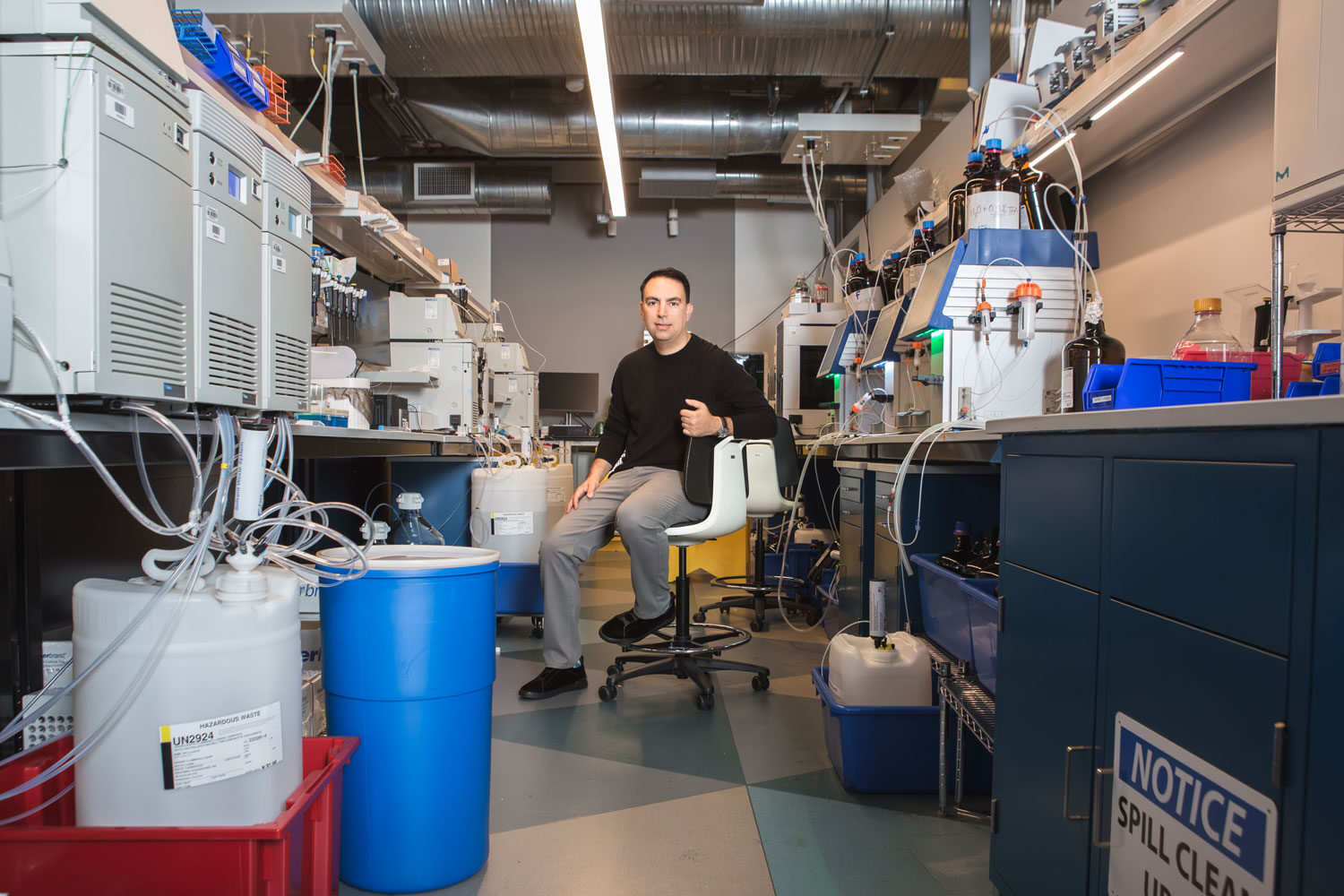
In 2011, Alborz Mahdavi (PhD ’15) was reading the latest edition of Nature when an ad caught his attention.
Breakthrough T1D, the leading funder of type 1 diabetes research, was announcing its Grand Challenge Prize, looking for innovative, molecular-level designs for a new class of insulins that could sense blood sugar levels and self-activate without requiring repeated injections.
Mahdavi was already building chemical biology tools that could target and track proteins, but his research had no direct connection to diabetes. Still, this was the kind of challenge he had been seeking. Years earlier, while working as a research associate at MIT, he had invented a biodegradable polymer adhesive that became a medical-grade glue now used worldwide. Mahdavi was driven to have that experience for himself. When he moved on to graduate school at Caltech, the bioengineering student admired the faculty’s commitment to finding simple solutions to the most complex and fundamental problems.
“This was a perfect problem for someone from Caltech to take on because it’s so technically challenging that most people would essentially write it off as impossible,” Mahdavi says. “It was also a problem that not only needed a solution but an elegant one. Building an extremely complicated molecule wouldn’t be practical for industry.”
“This was a perfect problem for someone from Caltech to take on because it’s so technically challenging that most people would essentially write it off as impossible,” Mahdavi says. “It was also a problem that not only needed a solution but an elegant one. Building an extremely complicated molecule wouldn’t be practical for industry.”
Mahdavi’s entry outlined how he would devise glucose-sensing insulin—and he won the cash prize.
By the time graduation approached in 2014, Mahdavi looked to secure funding so he could pursue his concept. The following year, thanks to a financial commitment from Breakthrough T1D, he launched Protomer Technologies in Pasadena to turn his idea into a real therapeutic.
Failing Forward
Glucose is a vital sugar that helps power life, including our own. Approximately four grams of glucose constantly course through our bloodstreams. Thanks to the human body’s remarkable machinery, the pancreas releases the precise amount of insulin into the body when it detects spikes in glucose levels. People with diabetes miss this precise regulation. When biological systems falter, it is up to the 830 million people around the world who live with this chronic disease to take the lead in their own glucose management. For the rest of their lives, they must engage in a series of finger pricks, injections, and re-tubing of insulin pumps.
“Initially, I was interested in technical aspects of solving this problem,” Mahdavi says. “I didn’t appreciate what people with type 1 diabetes, including the parents of a child with type 1 diabetes, go through until I met with families. [The disease] involves constantly thinking about blood sugar levels. It made me realize that we could not just touch the lives of millions of patients, but the people around them also.”
For people with diabetes to confidently and safely remove their insulin pumps and worry less about their blood sugar levels, a synthetic molecule must be able to detect surges in glucose and deliver the right amount of medicine at the right time. Each of these steps, as Mahdavi says, is “not trivial.”
Designing a synthetic molecule that can distinguish glucose from other sugars in the body is one such hurdle. Another is having the therapeutic bind strongly to a sugar molecule, but not so much that it becomes saturated and cannot detect rising blood sugar levels in the body. The biggest concern is over-activation: If a person indulges in soda or ice cream, which could have as much as 30g of sugar, the initial rush of sugar in the bloodstream could cause the therapeutic molecule to deliver too much insulin, potentially causing hypoglycemia—a serious medical condition that requires immediate attention.
To find a solution, Mahdavi and his colleagues took the long view. They dedicated Protomer’s early years to building a library of molecules and creating platforms that could identify the candidate molecules that bind to or detect glucose. Then, they screened each molecule to see if it could be a prime target for modification. The technology platform, known as Molecular Evolution of Peptide Sensors, is also now being applied to fight or cure other critical diseases, says Mahdavi.
“In searching for a solution, sometimes it’s hard to anticipate problems,” Mahdavi says. “We made no assumptions, other than that we were not clever enough to predict every problem. Instead, my team and I took each concept and tried to fail quickly in every way possible until we ran out of failure modes.”
Today, Protomer, which was acquired by Eli Lilly and Company, is in clinical trials with its glucose-sensing insulins. If Protomer’s molecules successfully pass the remaining phases of clinical trials, it could be five years or more before people with diabetes begin using the injectable pharmaceutical. But anticipation is growing: People with diabetes and their loved ones often remind Mahdavi, who now serves as vice president of Lilly research labs, what it is like to live with diabetes, and they ask when the pharmaceutical will be available. Those messages confirm Mahdavi’s decision 10 years ago to start Protomer and his dedication to impact.
“It would make me so happy if our innovations result in millions of people with diabetes not having to carry a pump or worry about their insulin injections,” Mahdavi says. “This is something the world needs.”