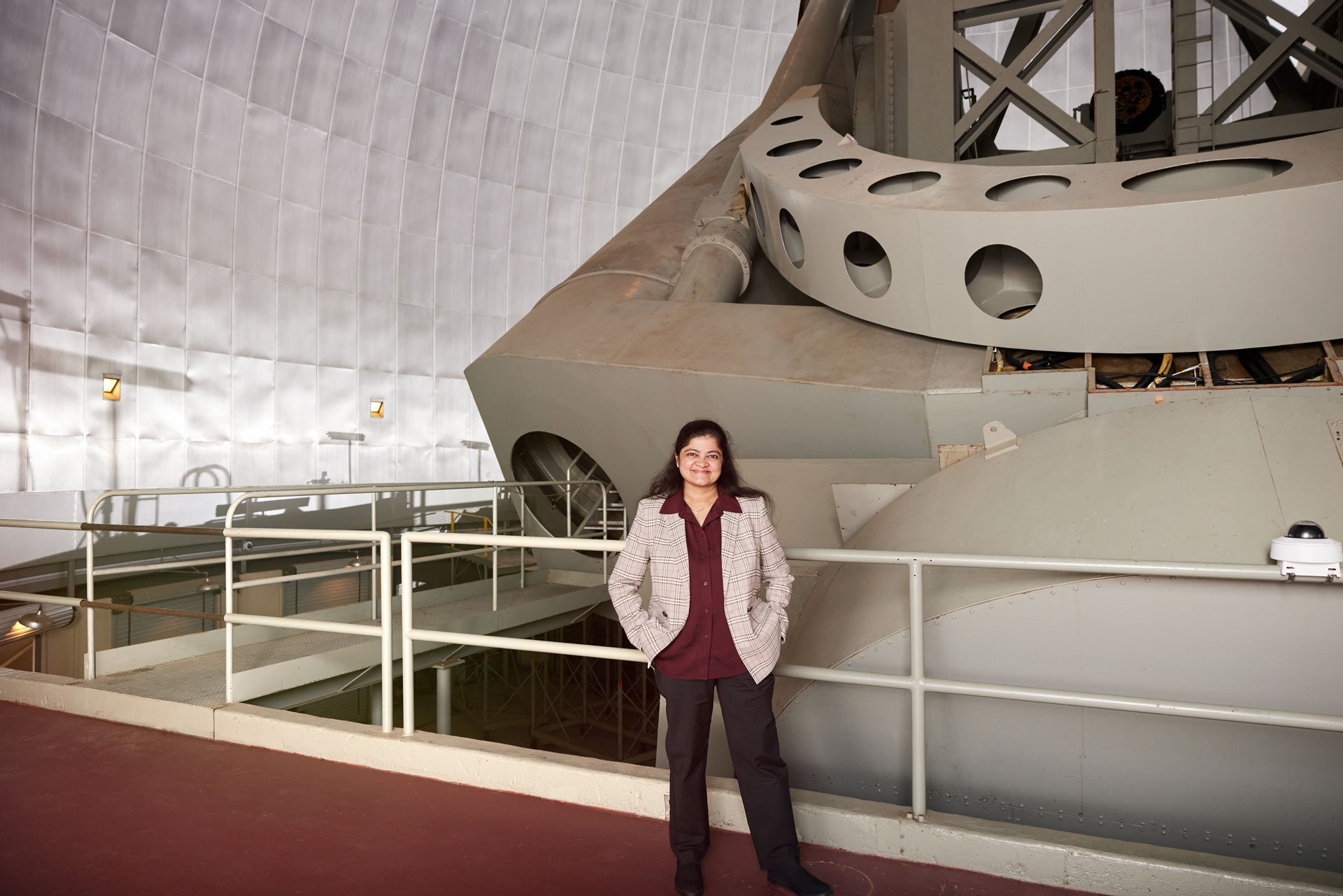
When Mansi Kasliwal (MS ’07, PhD ’11) first arrived at Caltech, with a bachelor’s degree in applied physics from Cornell University and a hunger for discovery, she felt like a kid in a candy store. “It was very dynamic,” she recalls. “There were seven faculty members with seven different thesis topics that I wanted to work on.” As she considered her options, her advisor, Professor of Astronomy Shrinivas Kulkarni, took her on a drive to Palomar Observatory, where he was then the director. On the way, he posed a deceptively simple question.
The universe, he explained, had revealed stellar explosions a million times brighter than the sun (classical novae) and a billion times brighter (supernovae), but what lived in the vast luminosity gap in between? Nothing in theory forbade such cosmic fireworks. Observers just hadn’t built the right experiments to find them.
For Kasliwal, that question—and the sweeping view of the mountaintop observatory—made her decision clear. “I just loved the place from the first visit,” she recalls. “I was all in.” She would spend her doctoral years chasing faint transients across the night sky, trying three different approaches to the luminosity-gap problem until a fourth finally worked. “There’s a good reason people had asked that question 50 years ago and still not answered it,” she says.

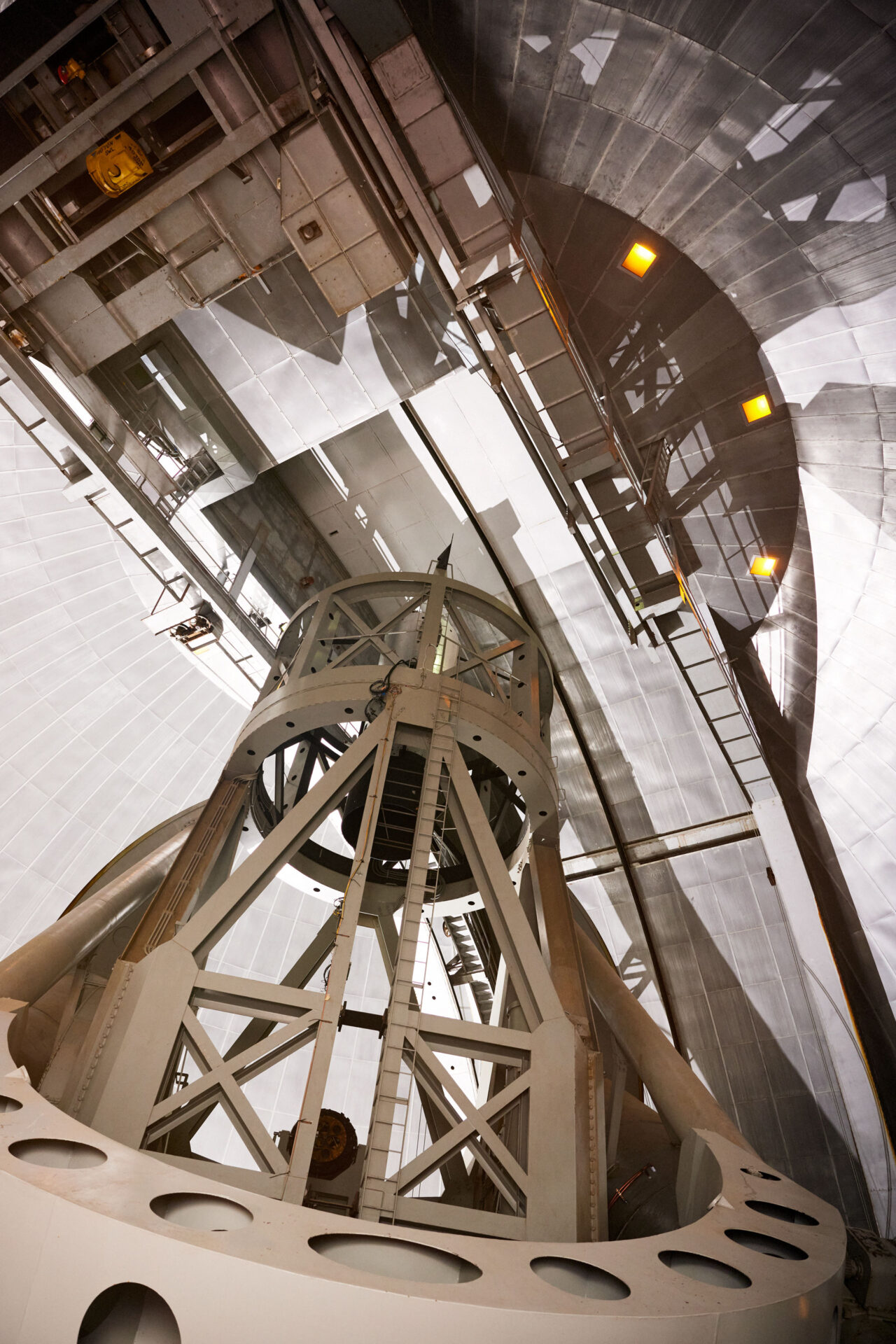

Palomar would remain central to Kasliwal’s research. After earning her PhD and completing a postdoctoral fellowship at Carnegie Observatories, she returned to Caltech as a faculty member in 2015, becoming a full professor of astronomy six years later. Along the way, she led major international collaborations. As the principal investigator of GROWTH (Global Relay of Observatories Watching Transients Happen), she coordinated dozens of astronomers and 18 telescopes across six continents to capture fast-fading transients in real time. She also became co-principal investigator of the Zwicky Transient Facility, which upgraded Palomar’s 48-inch Samuel Oschin Telescope with a wide-field camera capable of scanning the entire northern sky every two days for kilonovae, gamma-ray bursts, and other extreme phenomena.
In December 2025, Kasliwal was named the new director of Palomar Observatory—the tenth in its storied 78-year history, and the first woman to hold the post. For Kasliwal, who fell in love with science at an early age while growing up on a farm in India, it meant the kid was now running the candy store. “What Palomar does better than any other observatory on the planet,” she says, is to use its integrated system of telescopes to push the frontiers of astronomical discovery. “Our big, beautiful eye, the 200-inch Hale telescope, takes the gems discovered by the smaller robotic telescopes with the wide cameras, and gathers spectra to reveal what they are. There’s no other place like it.”
As director, Kasliwal balances scientific ambition with stewardship. She prioritizes instrumentation projects, evaluates new partnerships, oversees maintenance of aging facilities, and fundraises for cutting-edge upgrades. “There are always more ideas than reality has time for,” she says. Also vital are taking good care of her staff, who she deems “the real asset of the observatory,” and maintaining Palomar’s strong tradition of training the next generation: time is set aside for undergraduates and graduate students to lead proposals, conduct observations, and analyze data.
“If we can take this from a factor of three to a factor of seven, we are best in class for decades.”
Mansi Kasliwal
Her immediate priority has been commissioning the Next Generation Palomar Spectrograph (NGPS) for the Hale Telescope. Recently installed, the workhorse instrument delivers three times the optical efficiency of its predecessor. The gain is transformative, but there is a path to boost performance even further, and fundraising is already underway. “If we can take this from a factor of three to a factor of seven, we are best in class for decades,” says Kasliwal.
A longer-term vision is even more ambitious: identifying the next Earth. As Kasliwal explains, the 200-inch telescope is the right size to find such an exoplanet, but it requires the installation of a high-precision, radial-velocity instrument. Kasliwal acknowledges this to be the “toughest” of her challenges and estimates fifteen years for fundraising, construction, observation, and discovery.
“Since I became director, I sleep a little less,” she laughs, but her administrative responsibilities haven’t pulled her away from her research. “My own science interests are very aligned with the observatory’s mission,” she says, “so I don’t have to break away from my science to do right by the director job. I just have to jump in with both feet.
“What I love about astronomy,” she continues, “is how the universe can unveil a secret that is completely new.” Nine years ago, for instance, the first detection of light from gravitational waves caused by a collision of neutron stars revealed that roughly half the elements in the periodic table are forged in such cosmic explosions. “We take those elements for granted,” says Kasliwal, “but they’re made in these fireworks. ‘Where do the building blocks of life come from’ is a very simple question that you can answer through astronomical discoveries. That just makes me a very happy person.”