The Olives of Caltech
Olive Walk and the Athenaeum, 1991. Credit: Caltech Images Collection, Caltech Archives, 20.19-1.
History + Campus Life

The Olives of Caltech

In an excerpt from a 2022 oral history, former president Jean-Lou Chameau recalls how a chance encounter with students grew into a campus-wide harvest, and eventually, a $5 million bottle of olive oil.
By David Zierler
June 23, 2026

This piece is excerpted from To Illuminate Nature, from Molecules to the Cosmos: A Narrated History of Caltech Discovery from the 1920s to the 2020s, by David Zierler. A digital edition of the book is scheduled for release in September 2026.

Jean-Lou Chameau served as Caltech’s president from 2006 to 2013. Below, he describes how an unplanned encounter with students harvesting olives outside the Athenaeum became the Caltech Olive Harvest Festival, an annual tradition that drew hundreds to campus and helped shape the community-building thread that ran through his presidency.

We had been at Caltech for maybe six or seven weeks. I think it was on a Saturday, or maybe some evening, as Carol and I were walking back toward the Athenaeum, we noticed a bunch of students, who were shaking a tree trying to get some olives. They explained to us that they were going to try to make olive oil. I said right away, “If you make olive oil, you will bring your oil, and I will cook for you.” As typical Caltech students, they took action right away and, within a few days, they came to see me with a small bottle of olive oil, and they explained the way they had done it. I said, “OK, I’m going to make dinner.” Six of them came on a Saturday evening the following week, and I actually cooked dinner for them. In fact, I remember I cooked rabbit for them: Something very French! We had dinner, and we used the olive oil, and we tasted it, and so on.

Then the story took on a life of its own. Somebody talked to somebody who talked to somebody. The press heard about it, and newspaper articles appeared in the local Pasadena and Los Angeles papers. Then I got the idea to have a harvest of the olives, and let’s try to make Caltech olive oil. We found an olive oil company that was willing to help and give some advice. That group of students built their own press, and on a weekend we had hundreds of people — students, also faculty, staff members — who came to the campus to go up ladders, and I was one of them, to pick all the olives. They were pressed starting the same day and the following day.

Lance Hayashida. Courtesy of Caltech. Photo from the 2007 Olive Harvest Festival where volunteers harvested approximately a half-ton of olives.

Tom Mannion organized an outdoor dinner. All the way to the Athenaeum, hundreds of tables were lined up. I forget, maybe 1,000 people had dinner there at the end of the day. Again, we had amazing press coverage. The rocket scientists who are making olive oil! It went nationwide and, in fact, outside the US.

Obviously, the event helped change a bit the atmosphere. It was something fun. Everybody was involved. People loved it, and the trustees loved the idea. Mrs. Gordon Moore wanted to have olive oil taken to her, and I promised she would have a bottle at least once a year.

I will tell you a story. I will not give you the name, but there is one person I went to, a great supporter of Caltech who has passed away since then, and I said, “I’ll give you a bottle of olive oil, but, please, you have to make a donation.” It was five million dollars to Caltech for that bottle, and he made a five-year commitment. It’s always a matter of a bit of luck. Carol happened to walk on campus at the right time when students were shaking a tree. But then, also, I believe in terms of leadership, is to find when you can nudge luck in the right direction.
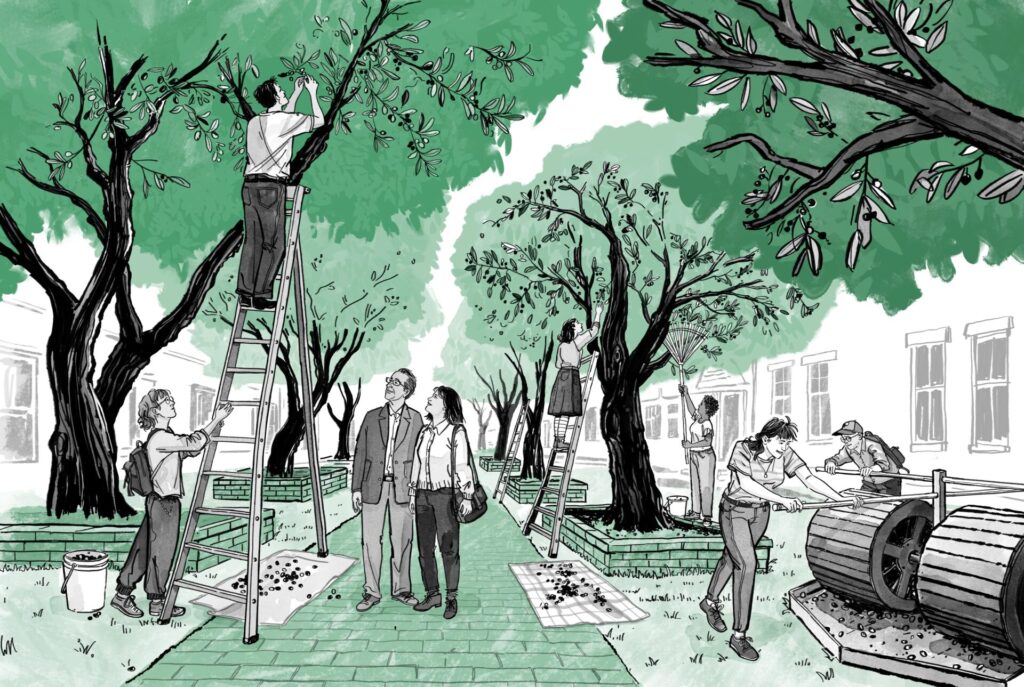
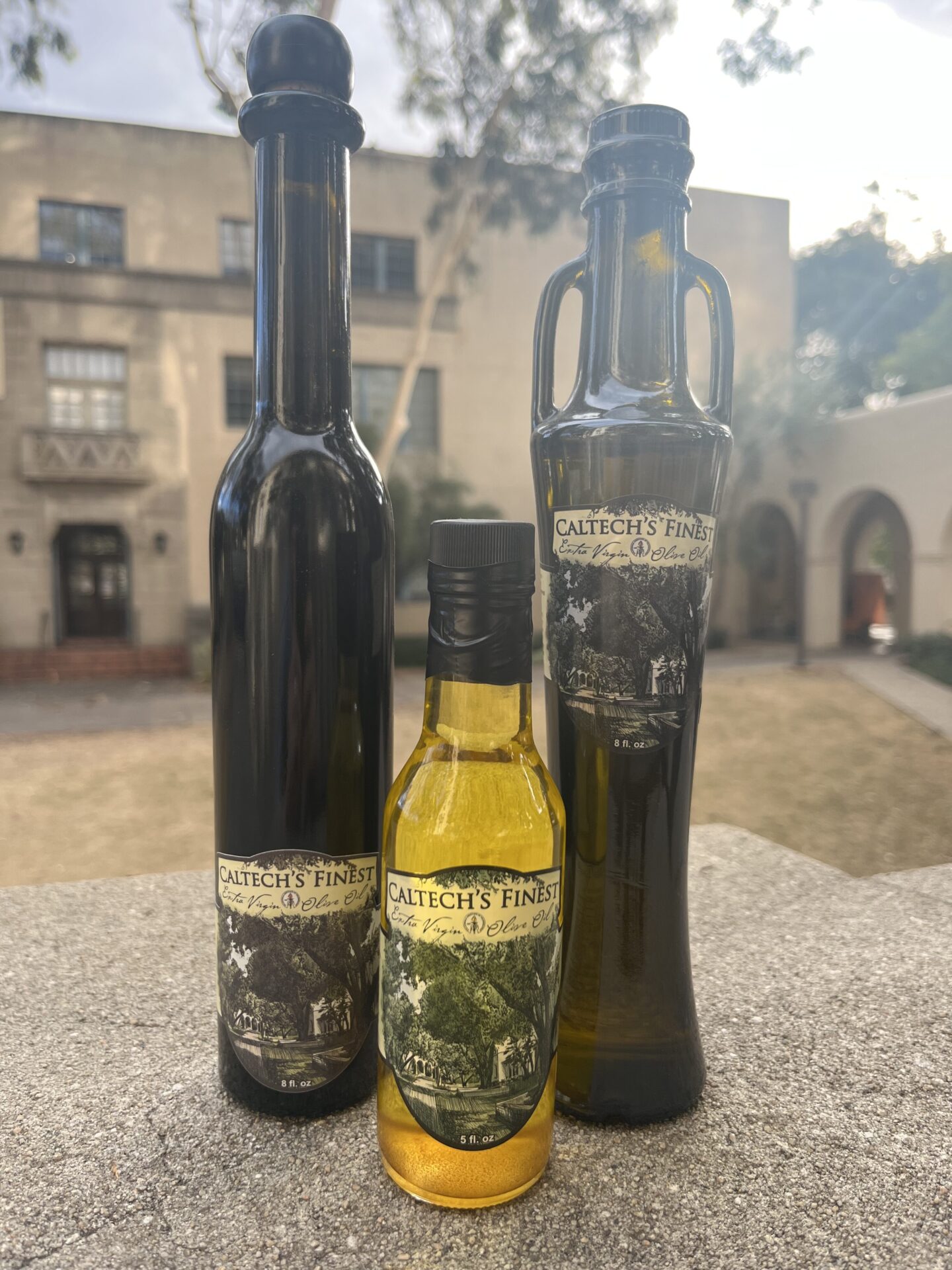
Illustration by Matt Lamothe

When George Ellery Hale returned to the United States from a trip to Italy in 1894, he was convinced of two things: the mountainous terrain combined with dry air made for the best astronomical observing conditions, and the architecture of the Mediterranean was sublime. Twenty years later, when Mount Wilson Observatory was firmly established as the greatest in the world but in need of a correspondingly great research institution, Hale saw his opportunity to transform the Throop College of Technology from a progressive vocational school into, ultimately, a campus enclave of stucco-clad arches, mission-style tiled roofs, a villa-like faculty club, Persian-inspired pools and mosaics, striking friezes, and elegant balconies overlooking symmetrical courtyards. In all, Hale envisioned, and ultimately executed, an architectural paradise featuring an eclectic mix of Old World detail nestled within the natural environs of the San Gabriel Valley.

The grandest horticultural feature of the brand-new California Institute of Technology, requiring decades of patience and planning, was the planting of olive trees, most prominently along the path that connected Throop Hall eastward to the Athenaeum. On that walk, if one felt transported to an ancient elevated olive grove somewhere along the Mediterranean Sea, well, that was the point. For anyone who has walked Caltech’s campus in November, it is unavoidable to observe that the trees are not merely ornamental. They produce copious amounts of olives that are bitter when young and smooth and perfect for snacking when slightly shriveled, just before they fall from the branch.

It seems inevitable that the French-born Jean-Lou Chameau, who became Caltech president in 2006, would seize the annual bonanza of olives as an opportunity for community building. For all the strategic advances that Chameau prioritized for the Institute — which included major investments in sustainability (both for infrastructure and research), a renewed focus on industry partnerships, and a long-term plan for Caltech’s financial security to enable world-class research — at the heart of it all was Chameau’s intrinsic appreciation of the power of human connection. The result was the Caltech Olive Harvest Festival, overseen by Chameau and his wife, Carol Carmichael, an environmental engineer and sustainability leader. From undergraduates to trustees, and from faculty to staff, each stage — from picking, to crushing, to bottling, and to cooking — brought a true farm-to-table experience to campus, creating exactly the esprit de corps that Chameau had hoped to achieve.

The timing proved vital. The festival unfolded just as the financial crisis of 2008 was threatening to wreck the American economy, which translated quickly into painful budgetary cuts across academia, Caltech included. Despite the challenges, Chameau’s administrative and business acumen was central to Caltech’s incredible achievement during this crisis: the Institute never stopped recruiting and hiring the best new faculty members, and progress in science and engineering continued apace through those difficult years. The lesson is obvious. Community-building was the sustaining factor that guided Caltech to a position of even greater strength and stability that connected the turbulent first years of Chameau’s presidency to the strength and stability that marked his last.

David Zierler is Senior Strategist and the Ronald and Maxine Linde Director of the Caltech Heritage Project.