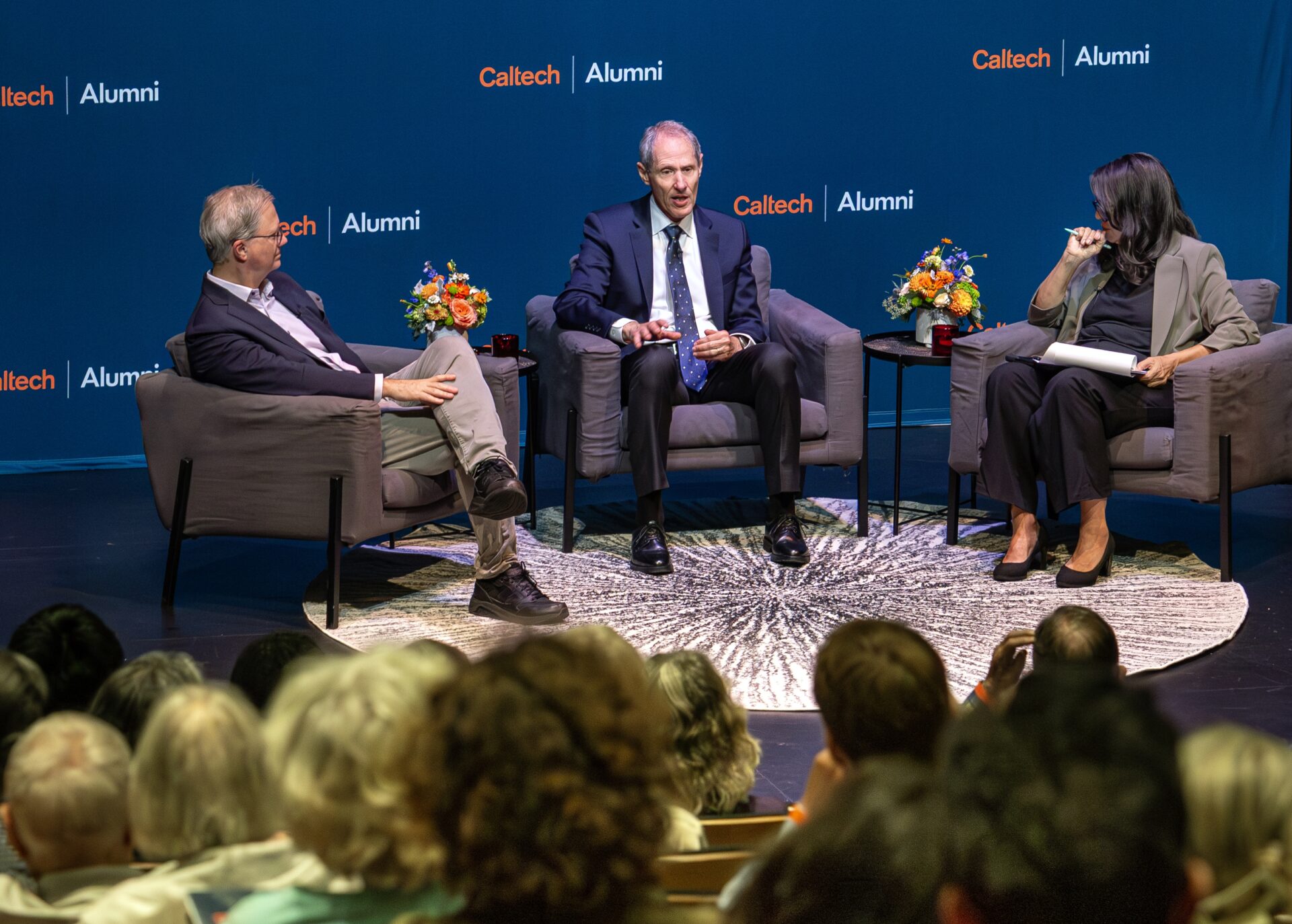
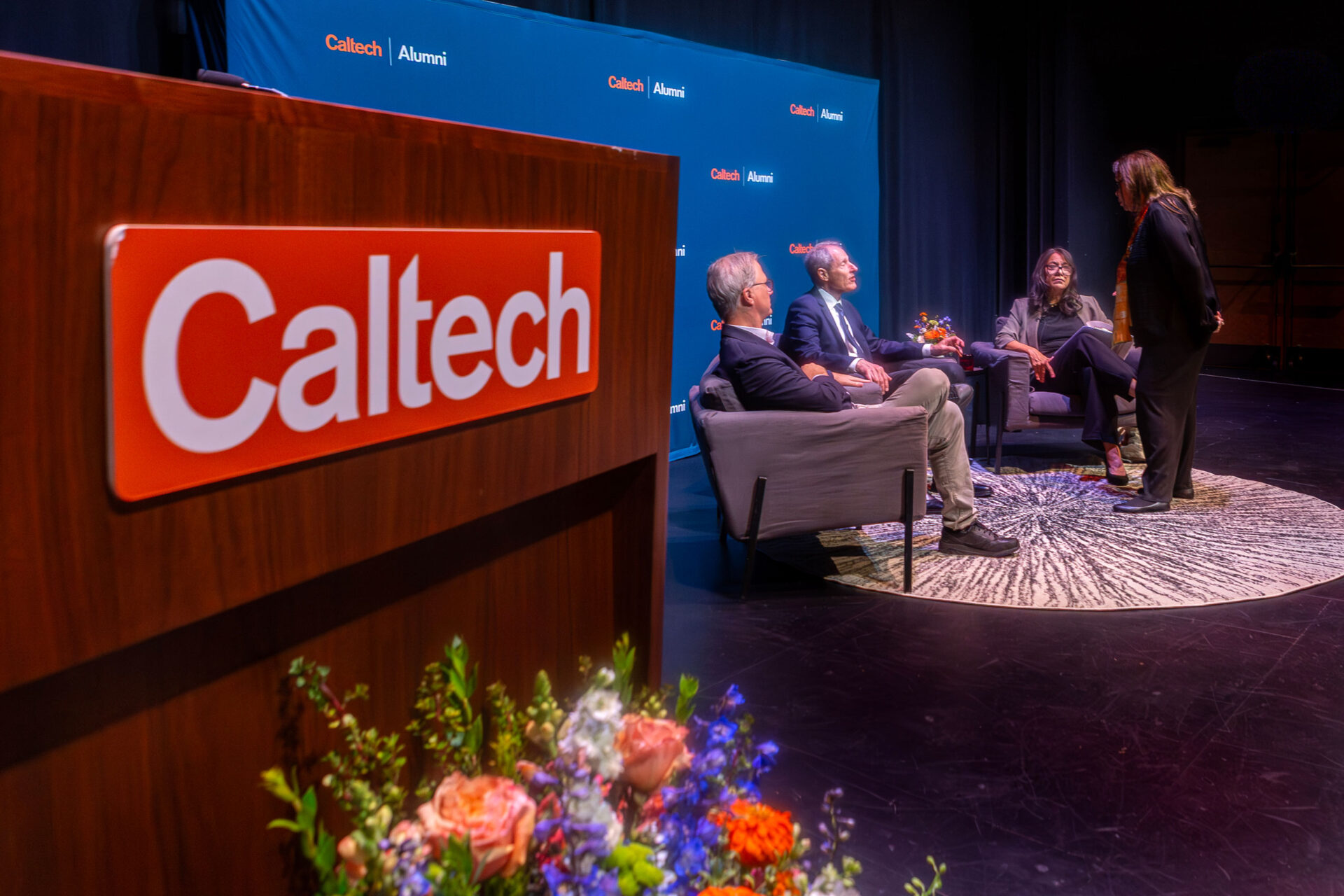
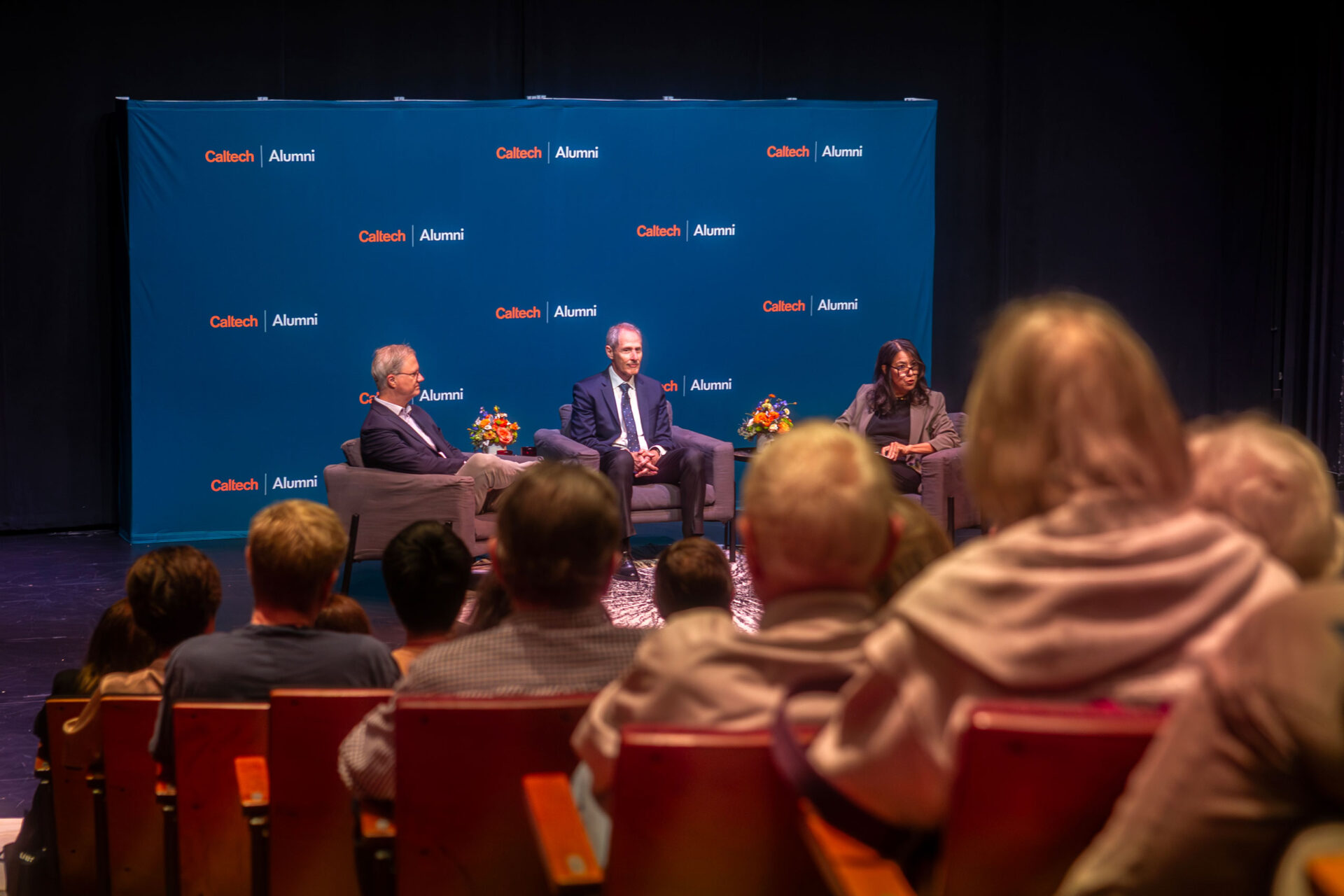
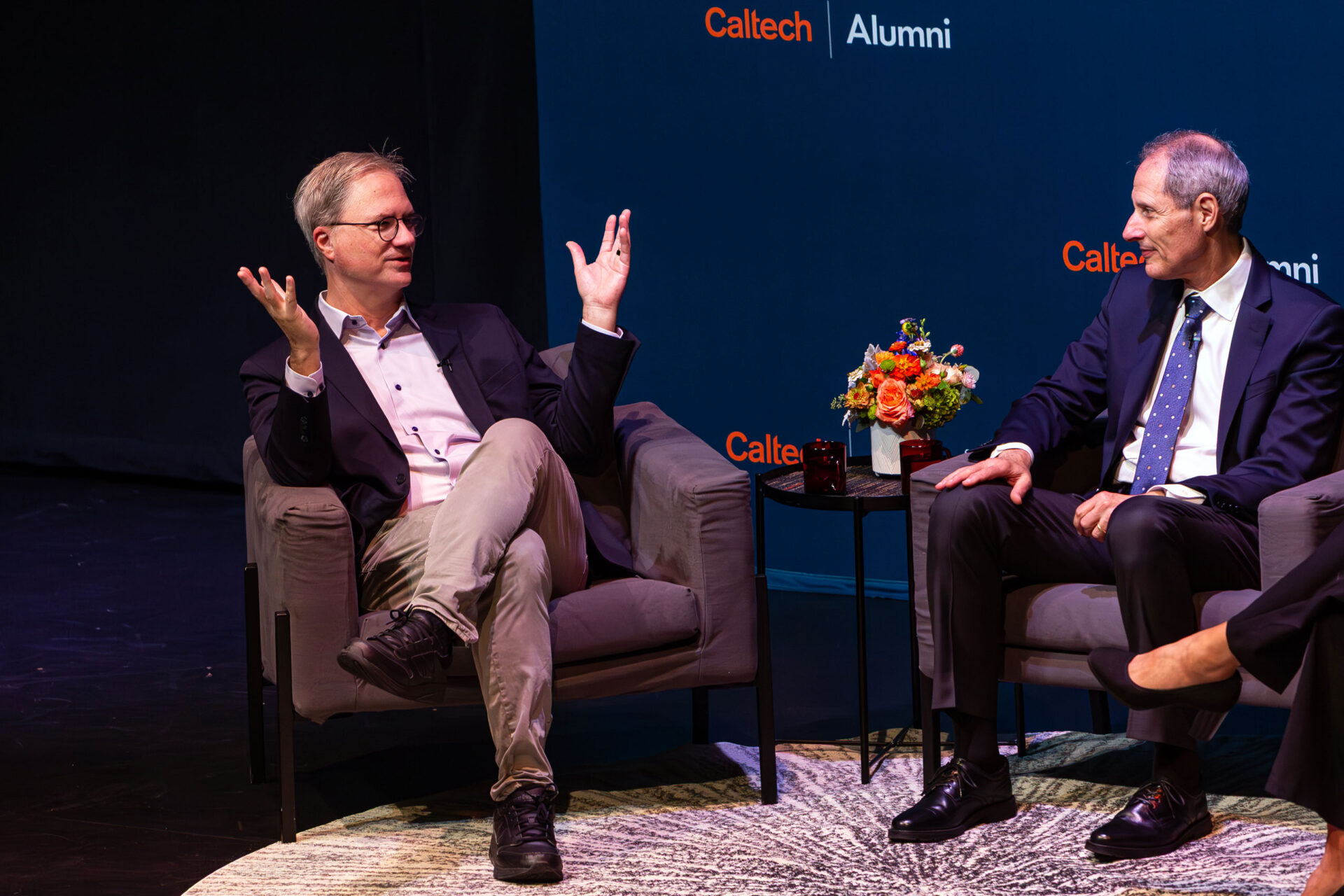
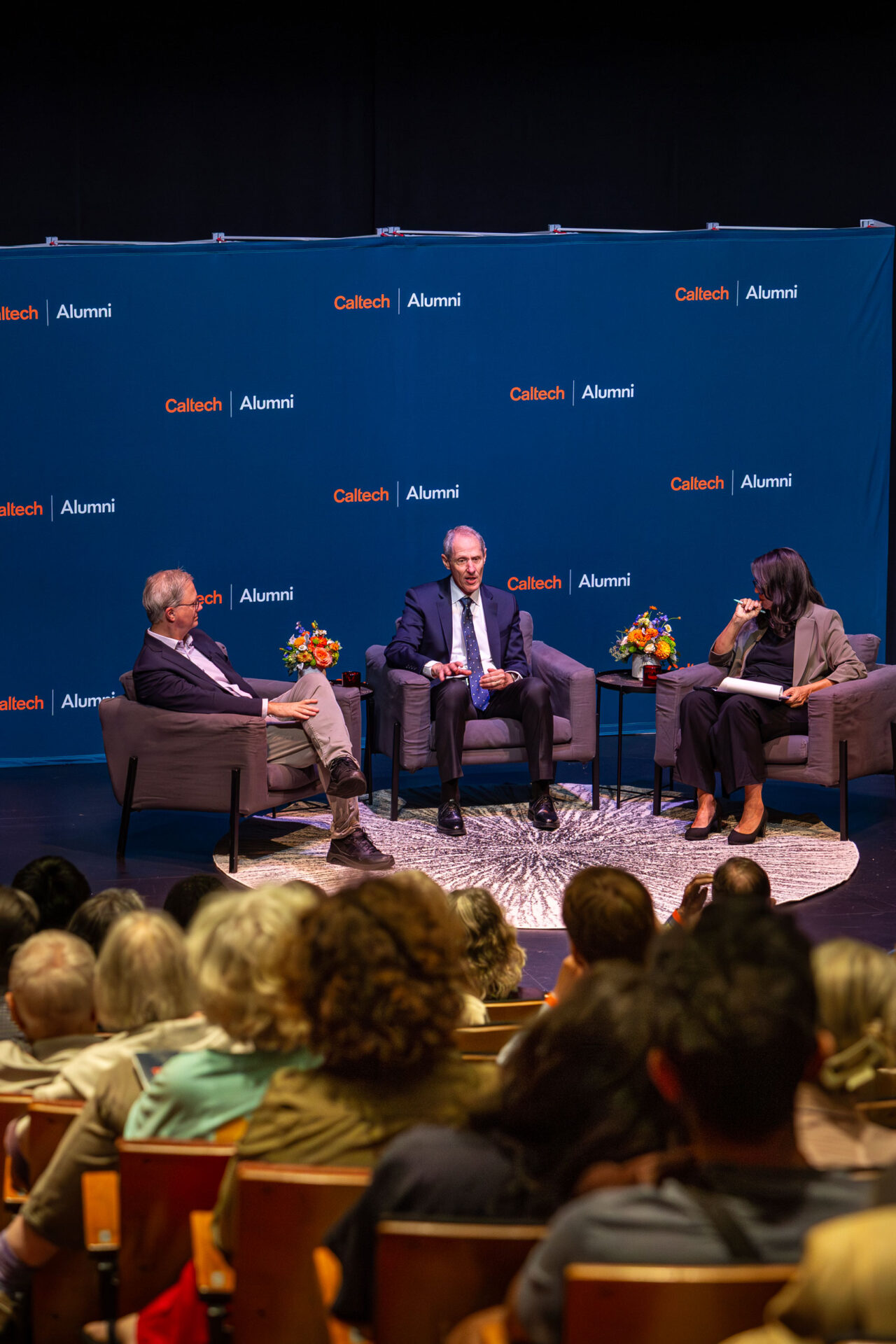
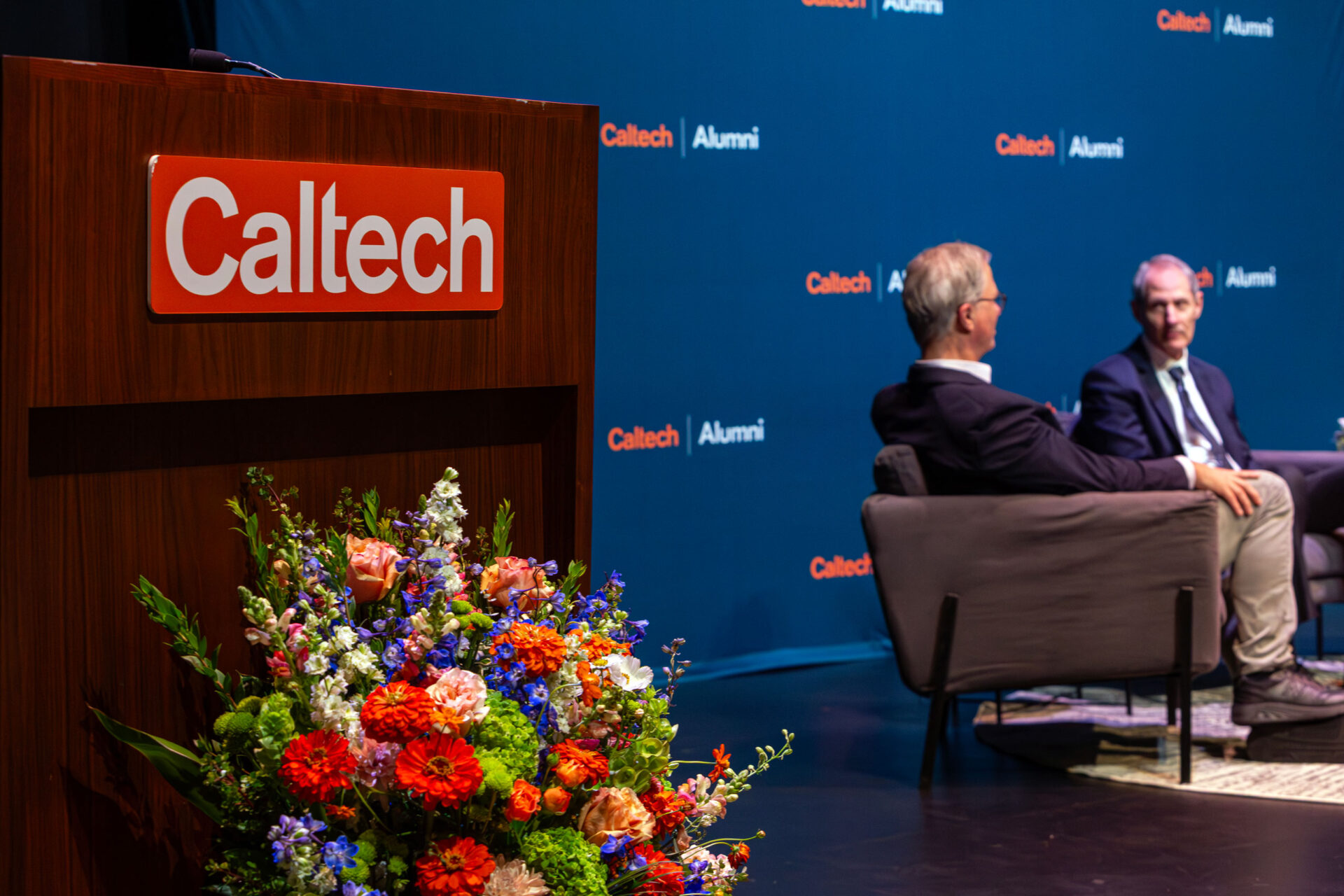
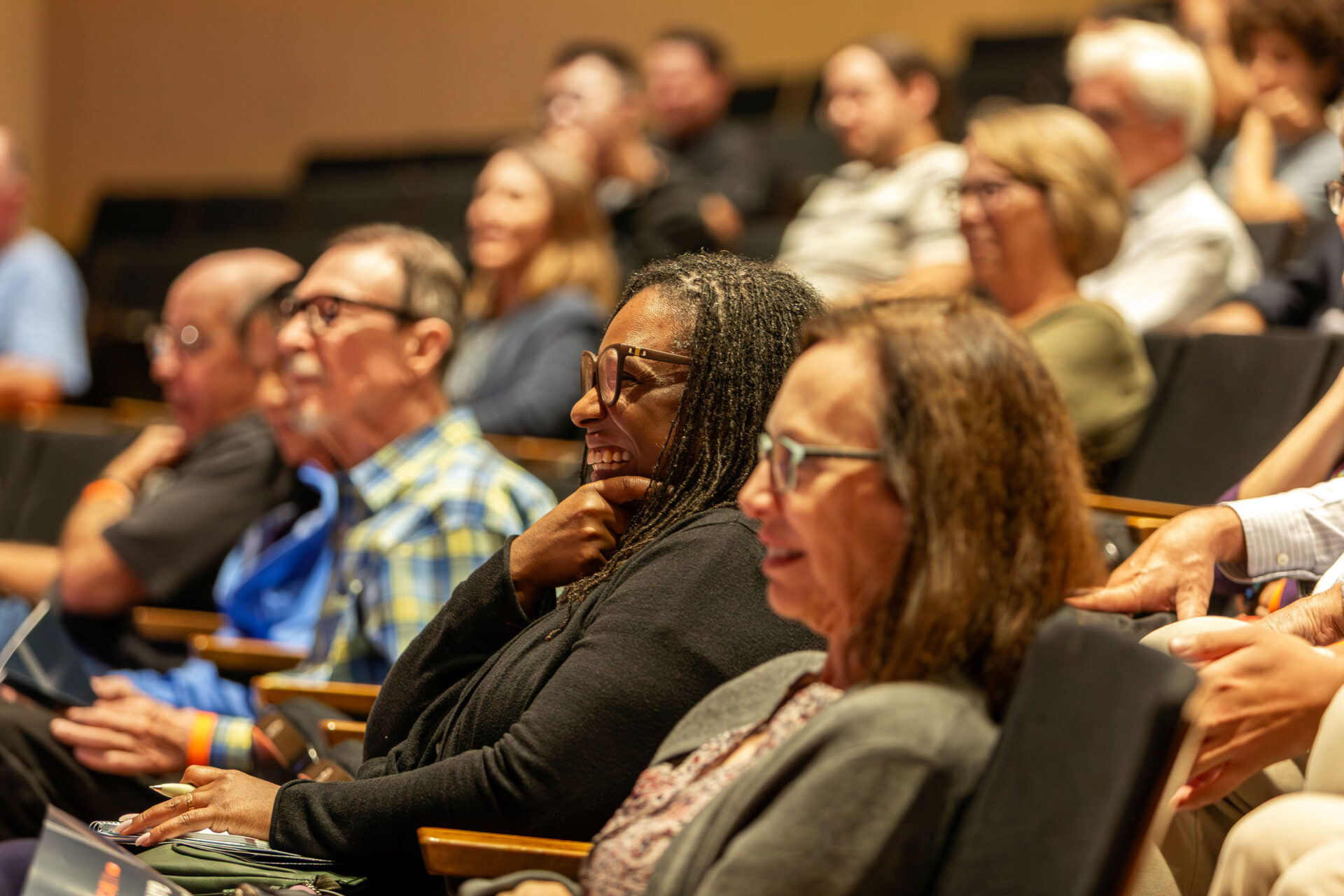
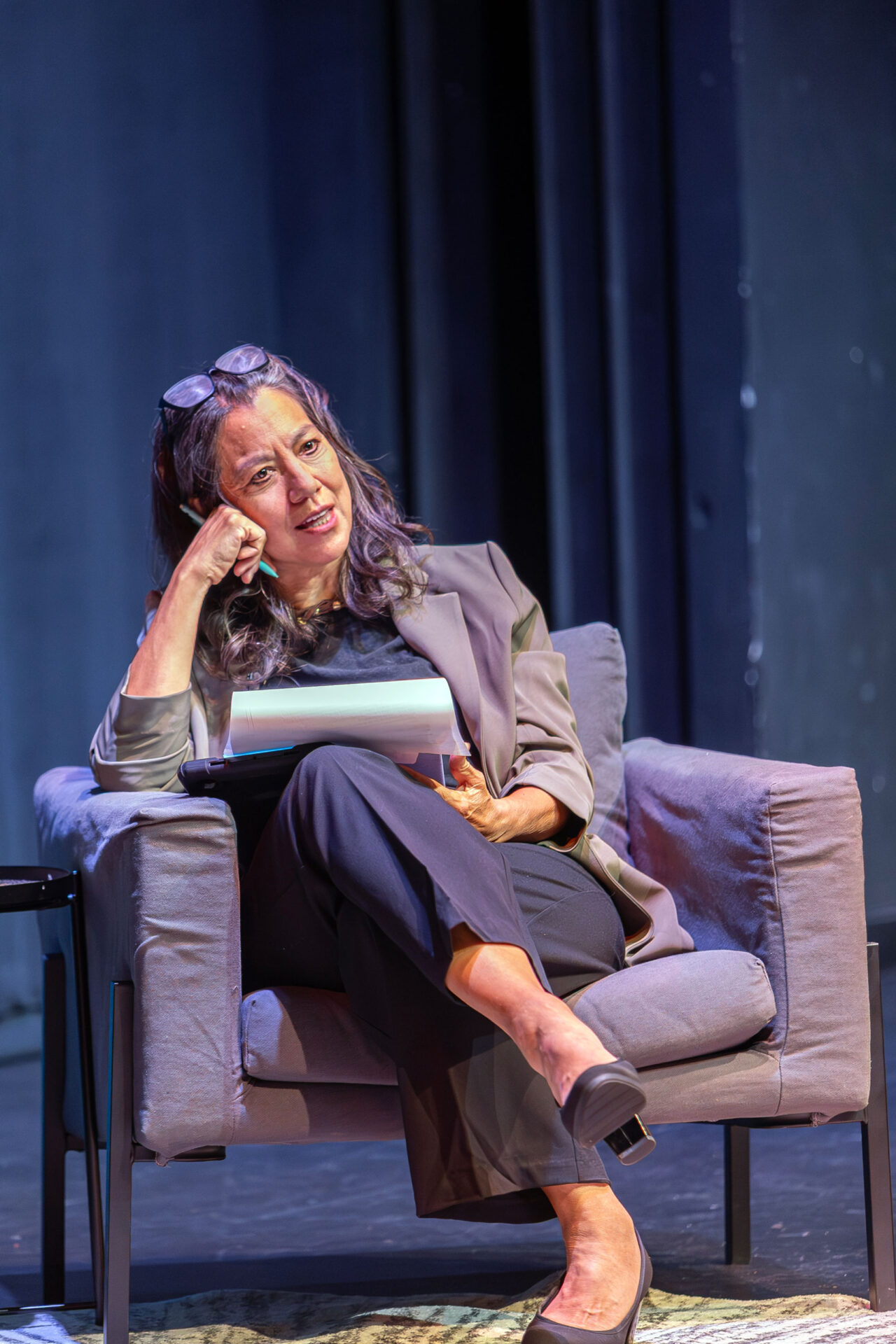
Ramo Auditorium, September 25, 2025 — Caltech Alumni kicked off its new Techer Live series with a fast-moving conversation on the state and future of American science. Moderated by writer-performer Sandra Tsing Loh (BS ’83), the program featured Thomas F. Rosenbaum, Caltech’s ninth president and the Sonja and William Davidow Presidential Chair and professor of physics, and Holden Thorp (PhD ’89), editor-in-chief of the Science family of journals and professor at George Washington University. Hundreds of alumni, faculty, students, and community members joined in person at Ramo Auditorium and via a global livestream.
View highlights from the evening below:
In an era of budget uncertainties and shifting public perception, what does the future hold for American science? That question brought together Caltech leadership, a leading voice in scientific publishing, and a community eager for answers.
The inaugural Techer Live event offered more than a diagnosis of challenges—it presented a roadmap, emphasizing the role of universities, the dedication of researchers nationwide, and the need to communicate science’s value to broader audiences. Across funding concerns and trust deficits, one theme emerged clearly: the Caltech community’s skills and commitment will be essential to navigating what comes next.
The state of science
President Rosenbaum opened the evening on an optimistic note. “It’s a fantastic time to be doing science. The questions we can ask are spectacular; the instruments we have are remarkable. We will know, in the next decade, if there is life somewhere else in our solar system, or on planets orbiting other suns,” he said. “We can look at individual cells and see which proteins they’re expressing; use AI to reconstruct three-dimensional images of tissues and identify which genes are expressed — insights that help us think about diagnostics and interventions to treat disease.”
“It’s a fantastic time to be doing science. The questions we can ask are spectacular; the instruments we have are remarkable.”
– President Rosenbaum
Thorp highlighted the people powering that progress: “What I find the most inspirational right now, from Caltech to land grant universities in the middle of the country and in the south,” he said, “is just the outstanding work that’s going on in science. People teaching and learning about science. The students and faculty and postdocs and the universities and staff that support them who are plugging along amid everything that’s going on, doing the work that they are called to do to help us make the world better. The dedication that I continue to see, to me, that’s the most hopeful and exciting thing that’s going on in science right now.”
Public trust
“If you look at the data, trust in science is still quite high,” Thorp said. “It’s come down over the last six years or so because of the pandemic, but it’s still higher than essentially any other institution.”
Reflecting on the past few years, he pointed to assumptions that academia must reexamine. “We took for granted that the data would win in the end — that if we found the truth, eventually people would come around to it. It turns out that it’s more work to get that across than we have planned for.”
Rosenbaum described an increased need to meet people where they are. “You can talk in the abstract about great scientific opportunities, but if you talk about how it relates to people’s lives, it’s much more approachable.”
He also mentioned the Caltech Science Exchange, a free public resource, and about Caltech’s efforts to make itself accessible to Americans of any socioeconomic background. “If your family income is less than a hundred thousand dollars, we’re completely free,” he said. “If your family income is less than $200,000, we’re tuition-free. We are accessible in many ways, although we are sometimes not seen that way by the public.”
Funding and policy
Tsing Loh then turned the conversation to a subject of many audience questions: government funding of science. Speaking from his Washington D.C. vantage point, Thorp described a mixed fiscal outlook. “Bipartisan congressional support for science funding is still strong, as it always has been in my lifetime,” he said. “Currently, the appropriations marks for the NSF and NIH look a lot better than the president’s budget, and that’s because great people have been working behind the scenes. But the worry is that the administration has been withholding money,” he added, creating real-world pain.
“Short-term, I think all major research universities will shrink to some extent,” Rosenbaum said. “It will affect graduate students and postdocs and the work we hope to accomplish for society.” He added: “Look at JPL — the world’s reservoir for space exploration — the proposal is to cut the budget roughly in half. It’s not viable.”
The innovation ecosystem
Caltech alum Ryan McDaniel ’03 asked: “The post-WWII model of collaboration between government funding and labs, academia, and industry has been the cornerstone of American science and invention for decades. Do you believe that model is now irretrievably broken? If so, what can take its place, and what do we lose in that transition?”
Rosenbaum answered first. “I don’t think it’s irretrievably broken, but it may change its form,” he said. “What isn’t broadly appreciated is that it’s an awfully complicated innovation ecosystem. There are lots of moving parts that are not interchangeable. You hear from some of the tech moguls, ‘If we don’t support universities, industry will just do it.’ Well, industry has no appetite to de-risk the technologies it wants to commercialize. We’re nonprofits; we’re set up to think about big ideas and develop new directions. When an idea becomes scalable and commercializable, it gets handed off. You can’t kill one part of the ecosystem and expect the rest to pick it up. The relationships may change, but the roles matter.”
On talent, Rosenbaum underscored a long-term imperative: “The United States has been able to compete while having a small portion of the world’s population,” he said, “because people of talent come to the United States. We need to welcome talent from abroad and encourage students in the U.S.”
Reasons for optimism
Both speakers closed by returning to what sustains them through uncertainty: the people doing the work. Thorp expressed gratitude for researchers who persist “in spite of all the challenges” — not just those in the lab, but educators, students, and communicators “giving tours at the science center.” His point was clear: science doesn’t depend solely on funding or political winds, but on the daily dedication of thousands who believe in science’s mission.
Rosenbaum struck a similar chord, though with a Caltech lens. “Being part of Caltech is a remarkable experience because of the people you meet,” he said — people who bring devotion to the scientific method to problems that desperately need it. It was both a tribute to the community in the room and a challenge: the world has issues that demand rigorous, evidence-based thinking, and Caltech graduates are uniquely equipped to provide it.
The evening’s conversation painted a portrait of American science at an inflection point. Strained but not broken, challenged but far from defeated. For alumni in Ramo and joining online from around the world, the call to action was clear. The scientific enterprise needs dedication of all kinds: advocates who will engage policymakers, communicate to skeptical audiences, mentor the next generation, and champion fundamental research when it’s under fire.
President Rosenbaum’s message to students applies equally to alumni: “Hold onto your dreams.” The quantitative skills and problem-solving mindset developed at Caltech aren’t just for the lab — they’re tools for navigating career pivots, industry challenges, and societal problems. The innovation ecosystem may be under strain, but ecosystems adapt. With scientists who refuse to give up, educators who keep teaching, and a community willing to fight for what matters, American science will find its way forward.
Techer Live is a new series presented by the Caltech Alumni Association, designed to bring timely, thought-provoking conversations to alumni worldwide—primarily online, with select in-person events.