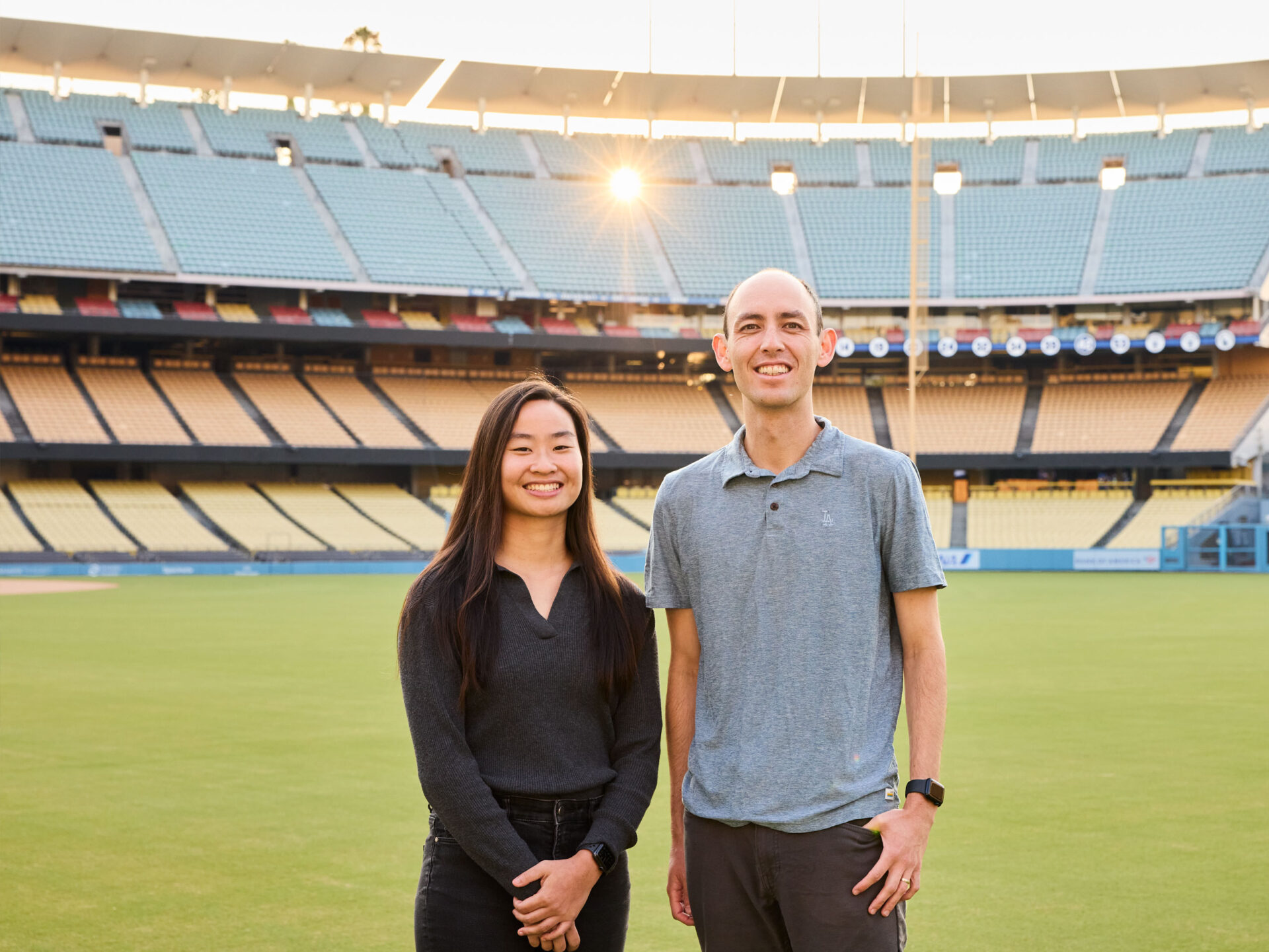
In the beginning, Ryan Casey, (BS ’15) admits, it was a struggle to get players to buy into statistical analysis.
He recalls an instance from the 2016 season. Dodgers center fielder Joc Pederson would consistently play shallow on defense in the outfield. “We told him one day, ‘You’ve just got to play way deeper and you’ll catch all these fly balls that are going over your head,’” says Casey, a developer in the team’s baseball systems unit. In the next series versus the Arizona Diamondbacks, the outfielder ended up making numerous catches at the warning track—catches he likely would have never made had he been playing as shallow as before. Pederson seemed surprised. “Oh, you guys are right,” he told them. Casey says it was one of the first times he saw his work impacting in-game results.
Casey came to the Dodgers that year after a master’s at UC Berkeley and a bachelor’s at Caltech, where he had walked onto the Beavers’ baseball team and helped the Division III program win its first game in nearly 10 years. The child of two alumni, Casey takes great pride in both graduating from Caltech and helping change the fortunes of the baseball team. “I contributed to increasing our winning percentage exponentially,” Casey says with a chuckle.
That achievement notwithstanding, a professional playing career was not in the utility player’s future. While Casey’s dream of playing for his hometown Dodgers was never going to pan out, he found the next best thing: a job in the team’s front office. Casey, a Valencia native, became the organization’s third software developer hire, charged with building tools and applications for the baseball operations department that streamlines the player evaluation process.
Today Casey counts at least a dozen developers and data engineers in the Dodgers’ baseball systems unit. The newest member of that team is fellow Caltech grad Grace Peng, (BS ’20). Before she took a job as a quantitative analyst with the Dodgers in 2021, the Bay Area native had dazzled as the Beavers’ star point guard, setting Caltech women’s basketball records in career scoring, field goals, and assists. She walked off the commencement stage in Pasadena almost directly into the front office at Dodger Stadium.
“I got lucky with the hiring,” says Peng. “I just saw the Dodgers had a job post up after I graduated and I applied. Being a computer science major, that was the dream coming out of school.”
Up until the June day I spoke with Casey and Peng over Zoom, Peng had served as a quantitative analyst for four years; she was part of a data science team focused on using mathematical modeling and statistics to build metrics for evaluating players and projecting performance. In other words, she and her colleagues helped the Dodgers build—and constantly refresh—its winning roster of on-field talent.
Our conversation happened at an auspicious moment: Peng would join Casey on the baseball systems squad the following week. Two days before we spoke, the Dodgers’ Japanese two-way megastar Shohei Ohtani had made his pitching debut for the club. The day after that, the boys in blue had beaten their National League West rivals the San Diego Padres to extend a four-game win streak. And just an hour before the three of us hopped on the call, news dropped that the Dodgers owner Mark Walter would be paying $10 billion to acquire another historic SoCal sports institution: the Los Angeles Lakers. The Dodgers are not just leading a renaissance in L.A. baseball but supercharging fan enthusiasm for SoCal sports across the board—and Casey, Peng, and their coworkers in the Dodgers’ front office have their digital fingerprints all over the team’s winning formula.
Playing the Numbers
Baseball’s current wave of data analysis was almost inevitable, although slow in arriving. Unlike other major sports in North America, baseball has always been about numbers—tallying, measuring, averaging, recording statistics, weighing the probabilities, and playing the angles. Sportswriter and statistician Henry Chadwick devised the box score as well as the simple formula for measuring a pitcher’s ERA (earned run average) back in the 19th century. Conventional wisdom from that era about baseball talent and strategy remained more or less fossilized until the early aughts.
Then baseball entered its Moneyball era, named after the 2003 book about how the Oakland A’s general manager Billy Beane updated the metrics for talent evaluation and subsequently took advantage of inefficiencies in the player market.
The Dodgers’ current golden era has coincided with a Moneyball-propelled explosion in data analytics and modeling in baseball, and the team has been operating at the forefront. In 2014, two years prior to Casey’s arrival, the team hired Andrew Friedman as president of baseball operations. Friedman had previously held the same position at the Tampa Bay Rays, a small-market team that punched above its weight because Friedman and his colleagues insisted on using data insights to drive their decision-making. With considerably greater resources at his disposal, Friedman pushed the Dodgers’ data operation into overdrive.
By that time, baseball was undergoing a data revolution leaguewide. In 2015, all 30 MLB ballparks launched Statcast, which uses radar and high-speed cameras to collect and analyze the on-field action. Today, that amounts to seven terabytes of data per game, equivalent to half a year’s worth of movies.
The Dodgers hired Dave Roberts as manager ahead of the 2016 season, around the same time that Casey came on board. In Roberts, the Dodgers found a coach who had mastered the interpersonal aspects of baseball management and had on-field bona fides, including a three-year stint as a Dodgers player and a famous World Series win with the Boston Red Sox. But crucially, Roberts was also not afraid to pay attention to the data.
Eight division titles, four National League championships and two World Series victories later, players are much more in tune with the data coming down from the front office.
That data is a deluge: Casey, Peng, and the baseball systems team provide insights that inform every pitch and at-bat in some way, shape or form. It all populates an ever-evolving arsenal of modeling and visualizations that feed into the team’s internal website, called 42 in honor of the civil rights and Dodgers icon, Jackie Robinson.
Casey, Peng, and the baseball systems team provide insights that inform every pitch and at-bat in some way, shape or form. It all populates an ever-evolving arsenal of modeling and visualizations that feed into the team’s internal website, called 42 in honor of the civil rights and Dodgers icon, Jackie Robinson.
Peng and her analyst teammates have created, for instance, the spray charts that lead to fielding recommendations—where defensive players should stand on the field based on a batter’s historical tendencies. These are perhaps the most obvious daily reminders of the importance of what Peng and her collaborators do. “Everyone has a little card in their hat that tells them where to stand,” she explains. “Anytime a new pitcher comes on and there are defensive shifts happening on the field, it’s cool to see.”
Casey agrees. “The coaching staff loves to use our 42 website to analyze every potential batter-pitcher matchup of the night, to see stats and project where and how to attack every single opponent,” he says. “I know that my tool is contributing to whatever strategy we’re employing that night.”
Deciding factors
Just how valuable are the data insights that people like Casey and Peng bring to bear? Lineup optimization alone is estimated to be worth five to fifteen extra runs over the course of a season. Ten runs can equal a win—which could make the difference between making the playoffs and not. “There are lots of in-game strategy things that cannot be fully answered by data—they require some sort of feel on the manager’s part,” says Casey. But Casey and Peng agree that data should factor into every baseball decision.
Peng says the data they crunch is getting even more granular; Casey says the next information arms race will focus on biomechanical data to analyze pitcher movements and batting swings. “Now, you have a skeletal footprint of every player,” he says. “Every team can track every player down to their limbs.”
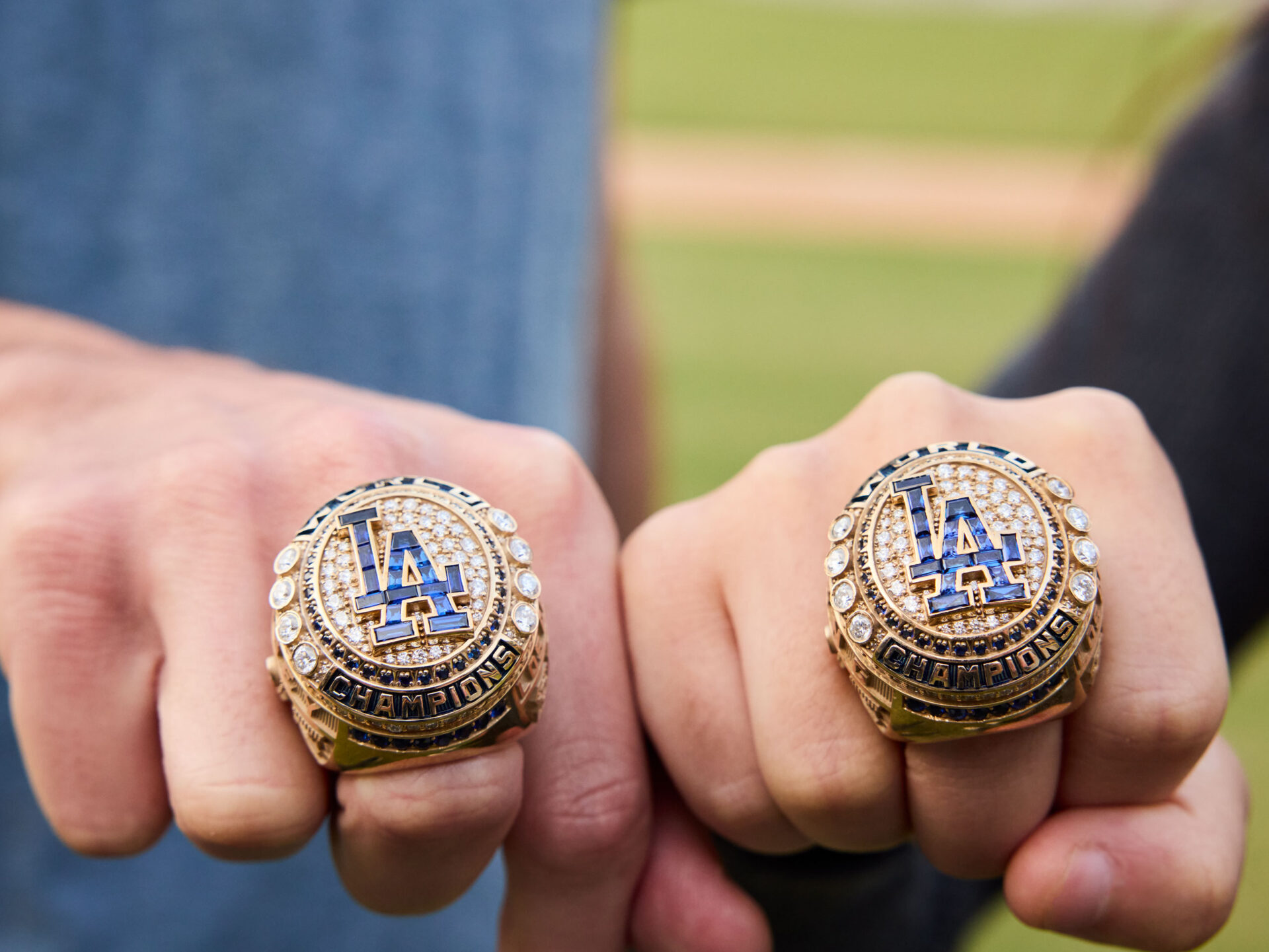
For now, they are making the most of the available data. This spring, they both received their 2024 World Series rings—a testament to the quality of the analysis that went into title-winning decisions. “It’s a really cool reminder I’ll always have of the journey to get there, and a validation of our work and the choice to pursue this career path,” says Peng. “It’s super humbling to be a part of something that big.”